
When an Experience Outgrows Its Stage
Great events aren’t static. The best producers pay attention to what resonates, what grows, where guests spend their time, and what deserves more space. At a certain point, the question shifts from maintaining the format to designing for what the experience has already become.
Enter Grand Fiesta at the San Diego Food + Wine Festival – one of the festival’s flagship events, and a celebration of the region’s deep connection to Baja California.
Over the past several years, Grand Fiesta has consistently sold out, with repeat attendance climbing and demand from chefs, brands, and partners outpacing what the original venue could support. There was no longer room to introduce new activations, expand participation, or evolve the experience in ways that matched its growth. The signal wasn’t subtle, it was structural.
Designing Around the Reality of the Experience
When an event reaches that point, scaling isn’t the strategy. Alignment is.
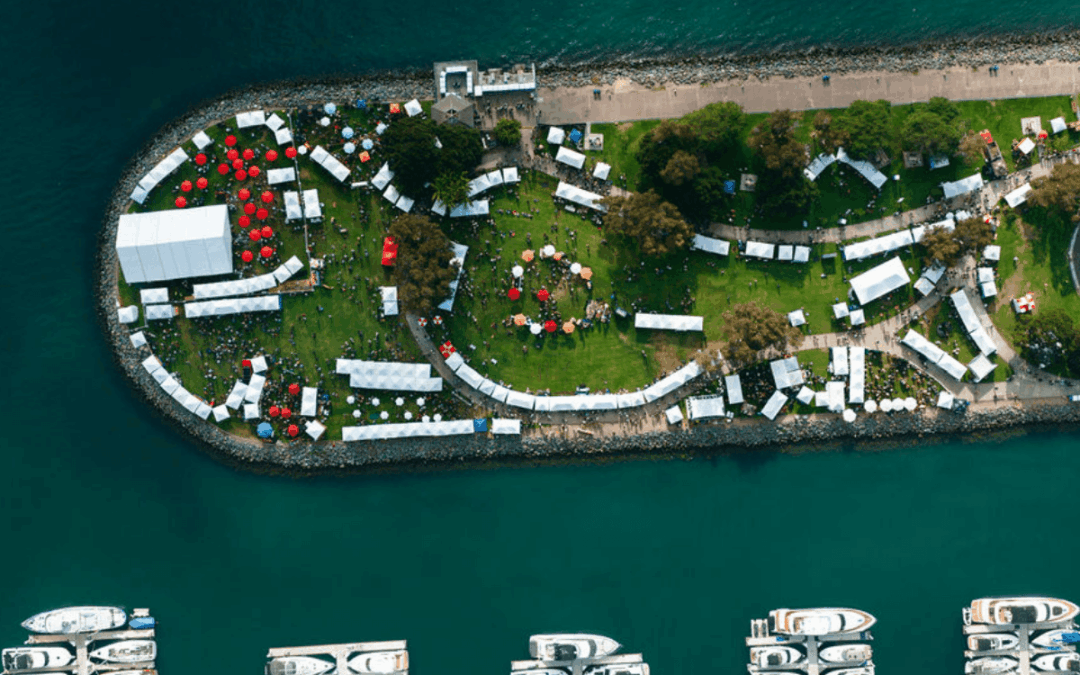
Historically, Grand Fiesta and Grand Tasting, the festival’s two largest events, took place in separate locations. Moving Grand Fiesta to Embarcadero Park alongside Grand Tasting brings both experiences onto the waterfront and creates the space to execute at a different level.
The setting allows for a more open, immersive environment, improved flow, and the ability to layer in additional chefs, exhibitors, and programming without compromising the guest experience. It also creates a stronger platform for partners, who can now participate across the weekend in more intentional and varied ways.
More space doesn’t just accommodate growth, it allows you to design for it.
Two Distinct Experiences, One Cohesive Weekend
With that shift, the festival’s flagship programming now takes shape as a two-day Grand Weekend.
Each day holds its own identity and point of view, while benefiting from a shared setting and continuity across the weekend. Guests aren’t moving between disconnected environments, they’re stepping into a cohesive experience that unfolds over two days.
That cohesion matters. It strengthens the guest journey, while also allowing chefs, brands, and partners to show up in a more complete way.
Preserving What Made It Work
As the format evolves, the responsibility is to protect what made the experience resonate in the first place.
Grand Fiesta has always been rooted in the cultural connection between San Diego and Baja California – a reflection of the region’s diversity, creativity, and shared identity. The chefs, the flavors, the music, and the energy that define the experience remain at its core.
What’s changed is the stage.
And with the right stage, the experience has the room to fully express itself – welcoming more guests, expanding participation, and deepening what has always made it meaningful.
The Role of the Producer
Moments like this are where the role of the producer becomes most visible.
Growth is often treated as a goal, but in practice, it’s a signal. It’s an indication that something is working and that the format may need to evolve to support it. The decision isn’t simply whether to expand, but how to do so without losing the integrity of the experience.
That requires restraint as much as ambition. Knowing what to change, what to preserve, and how to design around both.
The introduction of the Grand Weekend reflects that balance – not a reinvention, but a recognition that when an experience reaches a certain point, the responsibility shifts from maintaining it to building the right environment around it.